Tanzania – Probably the Funniest Book Ever Written About Tanzania
There are several perfectly sensible ways to write a book about Tanzania.
You could write about the Serengeti. Kilimanjaro. Zanzibar. The Great Migration. Lions looking magnificent at sunset while somebody with a very expensive camera whispers wow.
Martijn van Gogh somehow ended up writing about goats, barbers, buses, bureaucracy, broken-down vehicles, disappearing relatives, questionable building techniques, romantic misunderstandings, flexible appointments and an eighty-one-year-old Dutch accountant called Grandad Jan.
In retrospect, this may have been the better decision.
Tanzania: A Place Where Every Event Becomes a Life Lesson grew out of almost thirty years of travelling, working and living between Tanzania and the Netherlands. Martijn did not set out to collect stories. Tanzania simply kept providing them.
They appeared in markets and buses, homes and barbershops, villages and cities, during family visits, research projects, road trips and supposedly straightforward errands. Particularly supposedly straightforward errands.
Because in Tanzania, an ordinary day has a remarkable ability to lose control of itself.
A quick trip to the market can consume half a day and produce three new friends. A taxi journey can become relationship counselling. A haircut may include life advice and an assessment of your marriage prospects. A building project can challenge previously accepted definitions of straight, finished and today. And somebody who promises to return in five minutes may be expressing hope rather than providing information.
Martijn spent years experiencing these things.
Eventually, he did what any sensible person would do.
He wrote them down.
Is it really the funniest book ever written about Tanzania?
Possibly.
Hence the word Probably.
Martijn is ambitious, but not reckless.
What can safely be said is that Tanzania has provided him with almost thirty years of material, much of which would have been rejected from a novel for being insufficiently believable.
The inconvenient detail is that the stories are true.
No goats were added for comic effect.
No Tanzanian official was made more bureaucratic than necessary.
No family member was invented simply because the chapter needed another relative.
And Grandad Jan required absolutely no assistance from the author.
In fact, one of the challenges of writing the book was making reality sound plausible.
Come for the laughter. Stay for anything else.
At first, this is a funny book.
Hopefully a very funny book.
Possibly, subject to international verification and the availability of competing literature, the funniest book ever written about Tanzania.
But something else begins to happen between the goats, buses, family gatherings, barbers, builders and conversations that take several hours longer than anticipated.
Tanzania starts asking questions.
Not directly, of course. That would be terribly inefficient. It simply allows you to notice things.
Why are we always in such a hurry?
Why do we consider a completely full diary evidence of a successful life?
Why do people living twenty metres apart sometimes barely know one another?
When did efficiency become more important than attention?
Why do we need appointments to see friends?
And why are we so convinced that our way of organising life is the normal one?
Martijn encountered a Tanzania in which family can stretch far beyond biology, hospitality can take precedence over schedules, strangers can become acquaintances remarkably quickly and an afternoon in which absolutely nothing productive happened can still turn out to have been an excellent afternoon.
That does not mean Tanzania has discovered the secret of life.
It has traffic jams.
It has bureaucracy.
It has inequality, poverty and frustrations capable of testing even the most spiritually advanced traveller.
And sometimes the person who said five minutes really should have said Thursday.
This book does not romanticise Tanzania, nor does it present the Netherlands as a nation urgently requiring Tanzanian supervision.
It simply places the two worlds beside one another and asks:
Are we quite sure that everything we consider normal actually makes sense?
An irritating question.
Particularly when asked by a goat.
Not a travel guide
This book will not tell you which hotel to book in Zanzibar.
It will not provide The Ten Best Places to Photograph Kilimanjaro.
It contains no reliable advice about where to find lions.
And anyone attempting to use it to construct a Tanzanian public-transport timetable does so entirely at their own risk.
Instead, it takes you somewhere most travel guides cannot.
Into everyday Tanzania.
Into homes, families, markets, conversations, friendships, misunderstandings and the peculiar little moments that happen after the tourist attraction has finished and real life resumes.
It is a book about what happens when cultures meet — and both sides discover that the other one is behaving strangely.
Usually while being completely convinced that they themselves are perfectly normal.
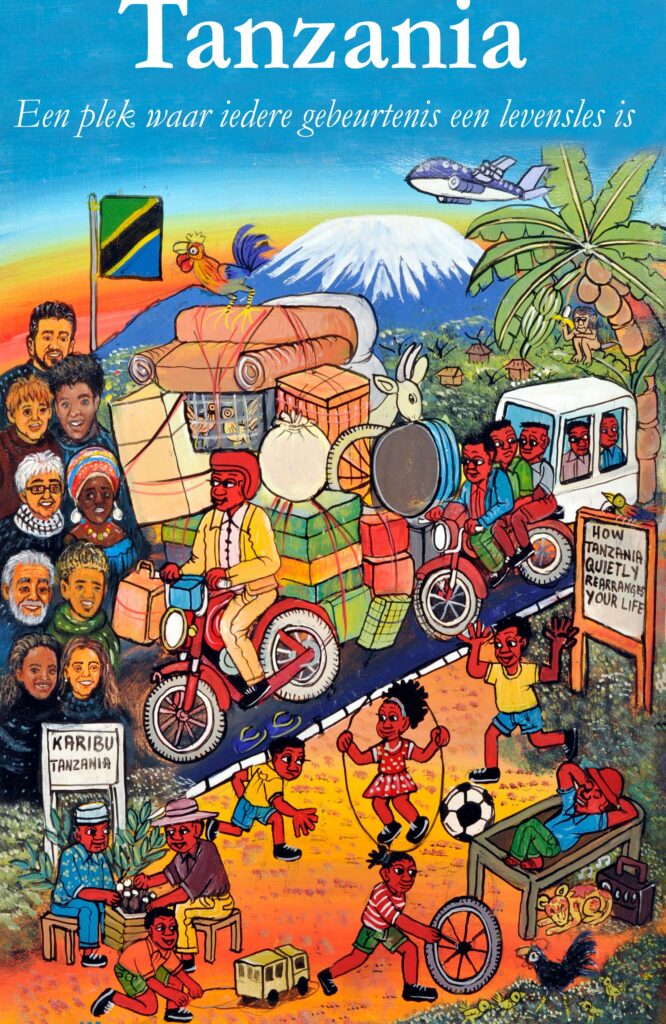
31 TRUE STORIES. 31 ORIGINAL PAINTINGS. ONE TANZANIA.
The book contains 31 true stories, each accompanied by an original Tingatinga painting created especially for the book by one of Tanzania’s renowned Tingatinga artists.
The paintings do not merely illustrate the stories. They create a second journey through Tanzania: exuberant, colourful, playful and unmistakably East African.
So this is not a book you simply read.
It is also one you wander through.
Preferably slowly.
Tanzania would approve.
What might happen when you read it?
You may laugh.
You may develop an unreasonable affection for Grandad Jan.
You may become suspicious whenever somebody says five minutes.
You may never look at a goat in quite the same way again.
You may start questioning why your calendar contains seventeen appointments next week.
You may unexpectedly want to learn Swahili.
You may begin talking to your neighbours.
In severe cases, you may book a flight to Tanzania.
The author accepts no responsibility for any of the above.
And then there are the life lessons
The title A Place Where Every Event Becomes a Life Lesson is deliberately playful.
But it is also serious.
Again and again, the smallest encounters taught Martijn something about resilience, family, generosity, creativity, community, humour and the extraordinary human ability to improvise when life has failed to consult the plan.
None of these lessons arrives with a motivational quote printed over a sunset.
They arrive disguised as ordinary life.
A conversation.
A mistake.
A ridiculous journey.
A stranger offering a chair.
A grandmother insisting you eat.
A problem solved in a way no Dutch risk assessment would ever have approved.
And perhaps that is why they stay with you. The book does not tell readers what they should learn from Tanzania.
It simply gives Tanzania 240 pages to make its case.
The book at a glance
Tanzania – A place where every event becomes a life lesson
Probably the Funniest Book Ever Written About Tanzania
Author: Martijn van Gogh
Price: € 24,95 including shipping & VAT
Edition: Premium full-colour softcover with flaps
Length: 240 pages
Format: 156 × 234 mm
Paper: 150 gsm GalerieArt Silk
Stories: 31 true stories
Artwork: 31 original full-colour Tingatinga paintings created especially for the book
Language: English
Binding: Smyth sewn and glued for additional durability
ISBN: 978 – 90 – 9043034 – 8 (Dutch version)
ORDERING & DELIVERY
Book price: € 24,95
Shipping within the Netherlands: Free shipping
International shipping: calculated during ordering
Payment: secure online payment, including iDEAL
Dispatched from: the Netherlands
Delivery: usually 1 – 3 working days after dispatch
Returns: 14-day right of withdrawal after receipt
ORDERING MORE THAN ONE?
Bookshops, companies, organisations, festivals, libraries and anyone planning to purchase an alarmingly large number of books are very welcome to get in touch for larger orders and special arrangements.
Leave Martijn a review on Google