Impact
What Martijn hopes to achieve with this book
Martijn wrote this book with one fairly uncomplicated ambition:
to make people laugh. Preferably quite a lot.
Fortunately, Tanzania has supplied him with nearly thirty years of material. Cultural misunderstandings, ingenious solutions, appointments with an unusually liberal interpretation of time, building projects in which today turned out to be more of a philosophical concept, relatives appearing without warning on the family tree, goats involving themselves in matters that were none of their concern, and perfectly ordinary afternoons developing into stories nobody back in the Netherlands was prepared to believe.
The difficulty was rarely making the stories interesting enough.
It was making the truth sound believable.
But the laughter has a purpose. Martijn believes humour is one of the shortest routes between people. Once we can laugh together about our different habits, assumptions and occasional absurdities, the other culture suddenly becomes rather less other. And sooner or later comes the mildly uncomfortable discovery that our own culture is every bit as peculiar. We have simply had more practice at finding it normal.
Nearly thirty years between Tanzania and the Netherlands have given him ample opportunity to examine both.
The Dutch, for example, are extraordinarily good at planning. We schedule, organise, evaluate and, when necessary, arrange another meeting to discuss why the previous meeting failed to produce sufficient measurable outcomes. We like efficiency, punctuality and the comforting belief that almost any human problem becomes manageable once somebody has created a spreadsheet for it.
Tanzania introduced Martijn to other possibilities.
Not necessarily better ones.
And very definitely not always faster ones.
But other ones.
He encountered a society in which family, community, hospitality, improvisation and simply having time for another human being can occupy a much larger place in everyday life. He also encountered poverty, inequality, bureaucracy and hardship that deserve no romantic treatment whatsoever. This book therefore makes no attempt to argue that Tanzania has discovered the correct way to live and the Netherlands has somehow mislaid the instruction manual.
Nor does Martijn propose abolishing Dutch planning and conducting all future government business beneath a mango tree.
Although he would be willing to participate in the pilot.
What he does hope is that the stories make readers curious. How much time do we still make for one another? How well do we actually know the people living twenty metres away? When did being terribly busy become evidence that life was going terribly well? Is efficiency always the same thing as progress? And is an afternoon really wasted if absolutely nothing on the agenda was accomplished but you came home with three new friends and an invitation to somebody’s wedding?
In that sense, Tanzania becomes a mirror. Not one that tells the reader how to live, but one that occasionally asks a rather inconvenient question:
Are you quite sure your way is the normal one?
Probably not.
Which is rather the point.
A Dream beyond the book
There is also a more tangible ambition behind the book.
Martijn wants to build a butterfly garden in Tanzania.
This began, as many financially questionable ideas do, as a dream.
The garden would bring together indigenous Tanzanian butterflies and plants, biodiversity, conservation, education and tourism. It would be a place where children, schools, families and visitors can experience the extraordinary natural world around them and learn why protecting it matters.
But Martijn wants the garden to create opportunities for people too.
And this is where the story comes full circle.
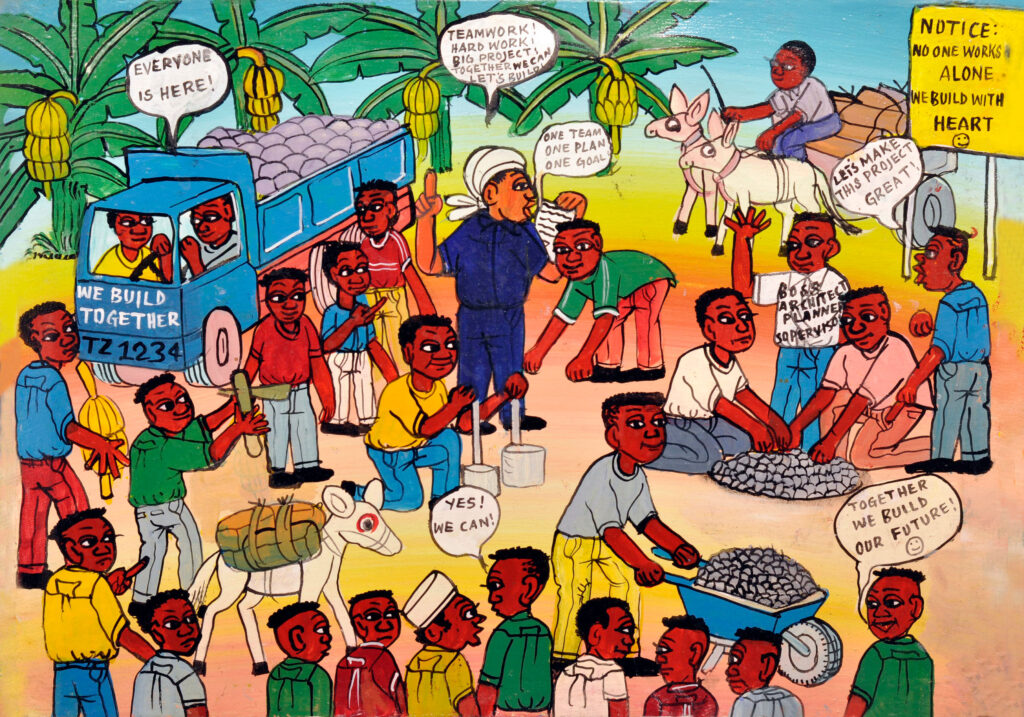
His relationship with Tanzania began in Mwanza in 1997, working and conducting participatory research with young people living and working on the streets. He later carried out research for UNICEF Tanzania into their daily lives and survival strategies. Nearly thirty years later, he hopes the butterfly garden can create opportunities for young people who live, or have lived, on the streets: a place where they can develop skills, take responsibility, gain experience and find paid work, whether in maintaining the garden, cultivating plants and butterflies or guiding visitors.
Not out of pity, but out of possibility.
A young person living on the street is not a street child. He or she is a young person with abilities, ideas, humour, ambitions and potential — some of which may simply never have been given much room to emerge.
Rather like a butterfly, although Martijn accepts that this comparison is now dangerously close to becoming inspirational merchandise.
He has, incidentally, developed considerable respect for butterflies as entrepreneurs. Their lives are short, which leaves very little time for procrastination. There can be no five-year strategic plan, twelve preparatory meetings or Working Group on the Sustainable Implementation of Butterfly Outcomes 2035. They emerge, get on with things, contribute to the ecosystem and move along.
Several organisations Martijn has worked for could perhaps take notes.
There remains one minor obstacle.
He does not yet have the money to build the butterfly garden.
His response to this financial difficulty was entirely rational.
He wrote a book.
As business models go, this is roughly equivalent to deciding to finance a hotel by opening a lemonade stand. But after nearly thirty years in Tanzania, Martijn has learned that a plan sounding improbable is not necessarily evidence that it will fail.
Every copy sold therefore brings the butterfly garden a little closer.
And if it succeeds, a rather unlikely circle will have been completed. Something that began in 1997 with a young Dutch student trying to understand the lives of young people on the streets of Mwanza may eventually become a place where many of the things that have shaped his life come together:
Stories and laughter. People and nature. Tanzania and the Netherlands. Curiosity about other cultures. Protecting biodiversity. Creating opportunities for young people. And bringing people together.
Perhaps that is ultimately what Martijn hopes this entire project will achieve.
That someone opens the book expecting to laugh.
Closes it looking at the world slightly differently.
And that somewhere in Tanzania, partly because of that same book, a butterfly opens its wings.
On schedule, presumably.